🃏 Strategy · Bluffing

When Should You Bluff?

A bluff isn't a gut call — it's a bet backed by math. Here's how to tell a profitable bluff from a hopeful one, before you fire it.

When Should You Bluff — a poker player considering a bluff at the table

Most losing players bluff for the wrong reason: it feels good, or it feels like "aggression." Most winning players bluff for one reason only — because the math says it's profitable more often than not, regardless of what's actually in their hand. A bluff doesn't need to work every time to be correct. It needs to work often enough to beat the price you paid to make it.

This is the framework for telling those two situations apart.

The Math

A Bluff Only Needs to Work Often Enough

Every bluff is a bet on fold equity — the chance your opponent folds a hand that would have beaten you. You don't need to know your exact fold percentage at the table, but you do need to know the break-even number you're chasing, because it's set entirely by your bet size relative to the pot:

Required fold % = risk ÷ (risk + reward)

  • ✓ Bet half the pot → you need your opponent to fold about 33% of the time to break even
  • ✓ Bet the full pot → you need about 50% folds to break even
  • ✓ Bet double the pot (overbet) → you need about 67% folds to break even

Any fold rate above the break-even number makes the bluff profitable on its own — and that's before counting the times you're called and still win at showdown, which is why a good bluff is usually a semi-bluff rather than a pure one. The smaller your sizing, the less the world has to cooperate for the bet to pay for itself.

Five Conditions for a Good Bluff

Check the Spot Before You Check Your Nerve

  • ✓ Your story is believable — the bet needs to represent a hand your actual range could hold, given how the hand played out
  • ✓ Their range is weak — the board or the betting line makes it likely your opponent missed, or is holding something they can't continue with
  • ✓ You have some equity left — a draw, a backdoor, or blockers to their calling range turn a pure bluff into a semi-bluff with two ways to win
  • ✓ The stack-to-pot ratio makes sense — there's enough behind to apply real pressure, but not so much that a call is cheap relative to their stack
  • ✓ The opponent can actually fold — a bluff against a station who calls anything isn't a bluff, it's a donation

Miss two or more of these and the bluff is usually a leak dressed up as aggression. Hit most of them and you don't even need to be right about your opponent's exact hand — the spot itself is doing the work.

Board Texture & Position

Where Bluffs Actually Work

Dry boards favor the preflop raiser. A flop like K♠ 7♦ 2♣ hits the raiser's range far harder than the caller's — which is exactly why a continuation bet on boards like this gets so many folds. You're not bluffing blind; you're representing a range advantage that's actually true.

Wet boards need real equity behind them. On a coordinated board — connected, two-tone, lots of draws — pure air bluffs get called down more often, because your opponent's range connects too. This is where semi-bluffing with a flush draw or open-ender earns its keep: even a called bluff still has outs to the best hand.

Position lets you bluff with less risk. Acting last means you see how the hand develops before committing chips, and you can apply pressure on a scare card that only you get to react to. Bluffing out of position works, but it needs a stronger story, because you're committing before you know how your opponent responds.

Turn and river bluffs need a consistent line. A bet that suddenly appears on the river after two checks tells a different story than one that's been building since the flop. Solvers and strong regs both read bet-sizing and line consistency — a bluff that fits the story you've told all hand gets through far more often than one that doesn't.

Common Mistakes

Why Most Bluffs Fail

Bluffing into a hand that can't fold. If a player has shown they call down with any pair, or any piece of the board, no story is believable enough. Save the chips and bet for value against them instead — that's where their leak actually pays you.

Choosing sizing that doesn't match the story. A small bet on a scary board looks like a blocking bet, not a nut hand — it invites a call instead of a fold. Sizing should match the range you're claiming to represent.

Bluffing with zero backup equity. Pure air bluffs — hands with no draw, no blockers, no path to improve — need a much higher fold rate to break even, and they have nothing left if called. A hand with even a little equity turns a bad river into a coin flip instead of a total loss.

Ignoring bet-sizing tells from your own history. Regulars remember. If your big bets have only ever meant value in this player's experience, a bluff-sized-like-value bet stops working the moment they've seen it fail to fold once.

Bluffing purely to "balance." Balance matters at high stakes against thinking opponents, but at lower stakes, most players aren't tracking your frequencies closely enough to punish an unbalanced range. Bluffing a spot just because "you should sometimes" — against someone who wouldn't notice either way — is giving up value for nothing.

Frequency & Balance

How Often Should You Actually Bluff?

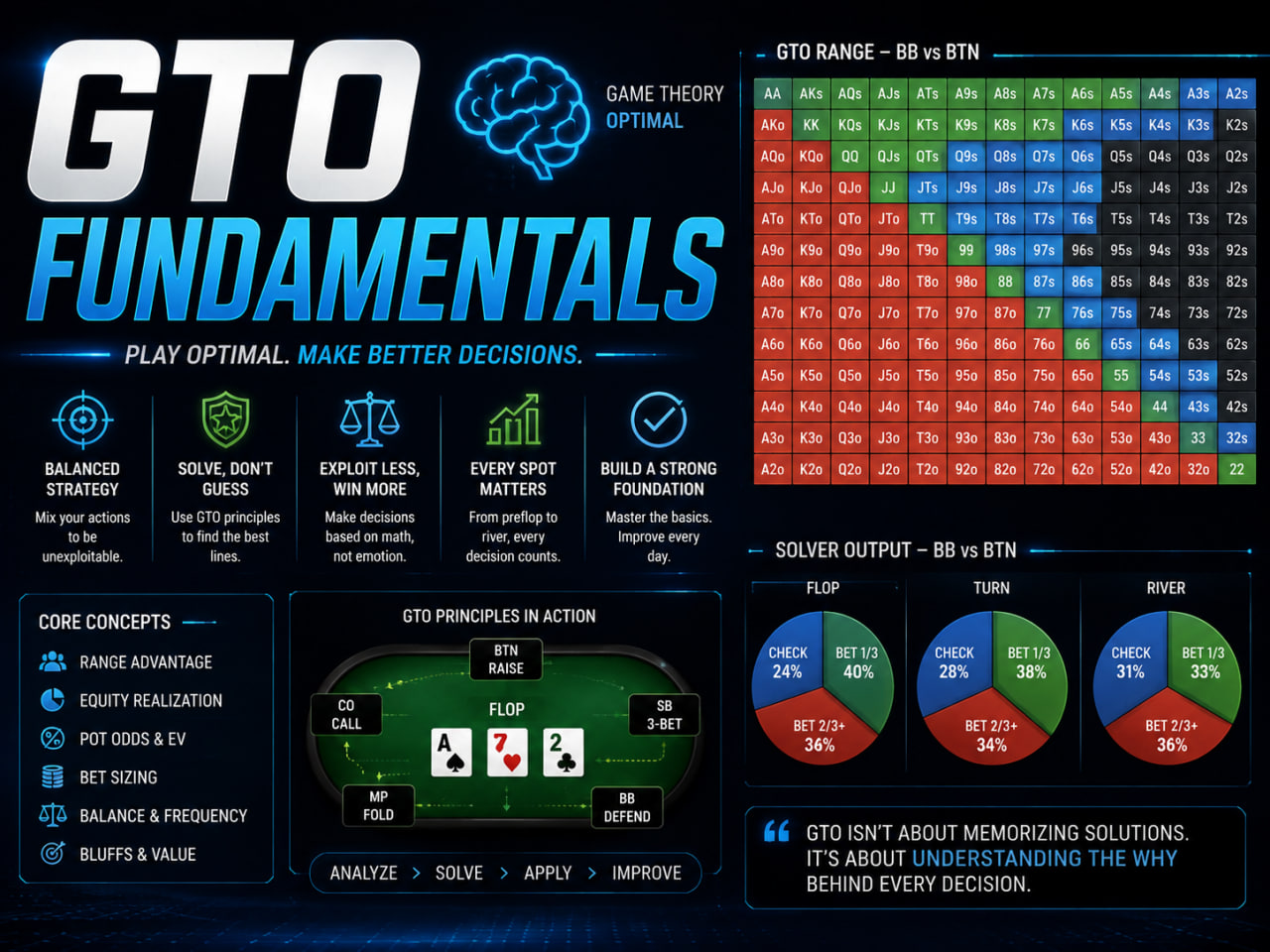
Against strong, observant opponents, your bluffing frequency on a given line should stay tied to your value-betting frequency, so your range can't be read from the bet size alone — this is the same balance principle covered in GTO Fundamentals. Against weaker or more passive opponents, the calculation shifts: if someone folds too much, over-bluffing them isn't a leak, it's the correct exploit. If someone almost never folds, the fix isn't a better bluff — it's fewer bluffs and more value bets.

The practical rule most winning players settle on: default to a balanced, GTO-shaped bluffing frequency when you don't have a read on the player across from you, then deviate deliberately once a real pattern shows up over enough hands. Guessing your way into an exploit against a decent player is usually worse than just playing the balanced line — and staying level-headed enough to make that call is its own skill, one covered in Mental Game & Tilt Control.

Ready to Put It Into Practice?

Bluffs land more often at tables with soft, exploitable opponents.

Related