❌ Strategy · Beginner Mistakes

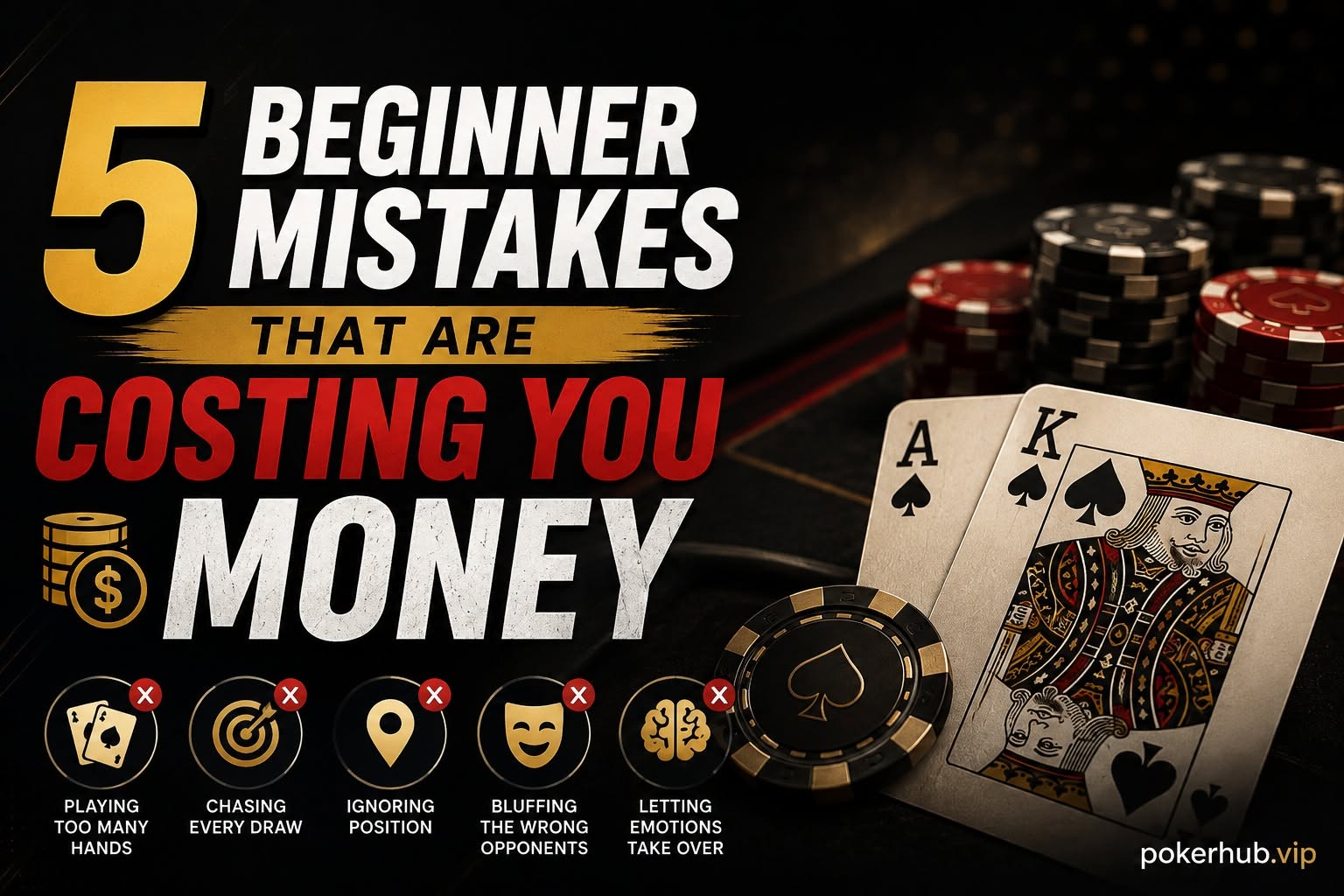
5 Beginner Mistakes That Are Costing You Money

None of these lose a huge pot on their own. Repeated for thousands of hands, they're the difference between a winning player and a losing one.

5 Beginner Mistakes That Are Costing You Money

Most beginners don't lose money because of one dramatic hand — they lose it a few big blinds at a time, in spots that never feel important enough to review. The five habits below show up at every stake and in every format, and they're the first things any decent player is quietly profiting from when they sit across from a beginner.

None of them require new theory to fix. They just require noticing you're doing them.

At a Glance

The 5 Mistakes

  • Playing too many hands
  • Chasing every draw
  • Ignoring your position
  • Bluffing the wrong opponents
  • Letting emotions take over
Mistake #1

Playing Too Many Hands

Just because you can legally play a hand doesn't mean you should. Every hand you enter with a weak holding is a small, ongoing donation to the players who stay disciplined — you'll be out of position more often, miss more flops, and face more tough decisions with less to show for them.

Patience is one of the biggest edges in poker precisely because so few players have it. Tightening your opening range, especially from early position where more players are still left to act behind you, cuts out a huge share of the marginal spots that bleed money over the long run. It won't feel exciting. It will show up in your results.

Mistake #2

Chasing Every Draw

Not every flush draw or straight draw is worth a call. Whether chasing one is profitable comes down to pot odds — the price you're being asked to pay relative to the size of the pot — compared against your actual equity to complete the hand. A draw that's a clear call for 5% of the pot can be a clear fold for 40% of it, even though your cards haven't changed at all.

The habit to build is thinking in terms of pot odds and expected value before calling, not just "I might hit it." Factor in implied odds too — how much more you stand to win if you do hit — but don't let a hope of future money justify a call that's already bad on the numbers in front of you.

Mistake #3

Ignoring Your Position

The later you act in a hand, the more information you have — you've already seen how everyone else responded before you have to make your own decision. That information is worth real money: it lets you play more hands profitably from the button than from under the gun, and it lets you control pot size and extract more value when you do have the best of it.

Beginners tend to play a similar range of hands regardless of seat. Winning players do the opposite — tightening up early, opening up late — because position is power, and power is worth using deliberately rather than ignoring.

Mistake #4

Bluffing the Wrong Opponents

A bluff only works on someone capable of folding. Some players simply love to call — they'll pay off a big river bet with a hand that has almost no business being there, not because they've read your line correctly, but because folding isn't part of how they play. Bluffing them isn't a mistake in theory, it's a mistake in target selection.

Save your bluffs for opponents who've shown they can let go of a hand — tighter, more thinking players who fold to aggression when the story makes sense. Against calling stations, the better plan is the boring one: value bet relentlessly and let their calls pay you off instead.

Mistake #5

Letting Emotions Take Over

A bad beat is frustrating — losing a pot you were supposed to win, sometimes by a single card, is one of the most viscerally annoying things in poker. But chasing that loss, playing looser or more aggressively to "get it back," almost always turns one bad result into two. The math of the hand you just lost has no bearing on the next one.

Staying disciplined after a loss is a skill like any other, and it's worth building deliberately rather than hoping it shows up in the moment. For a deeper look at what actually causes tilt and how to build resistance to it, see our guide on Mental Game & Tilt Control.

Ready to Put It Into Practice?

Cutting these five leaks matters most at rooms with a soft enough field for the fix to actually show up in your win rate.

Related