The same two cards are worth more in some seats than others. Here's how to adjust your range and strategy at every position around the table.
Ask any winning player which single skill improved their results the most, and "playing tighter early and looser late" comes up more than almost anything else. Position isn't a minor factor to consider once your hand and the board are decided — it's one of the biggest edges in the game, and it's the one edge that's available to you on every single hand, regardless of your cards.
Here's what changes at each seat, and why.
Acting last on every street means you get to see what everyone else does before you have to decide anything. That information compounds: you know whether the pot was raised or limped, whether it's been called or 3-bet, whether opponents checked or bet the flop — all before you commit a single chip. Acting first means doing the opposite: making decisions blind, then watching how the rest of the table reacts to a choice you've already locked in.
What position actually buys you:
This is why the same starting hand — say, A♦ T♣ — can be a clear fold under the gun and a clear raise on the button. The cards didn't change. The information you'll have for the rest of the hand did.
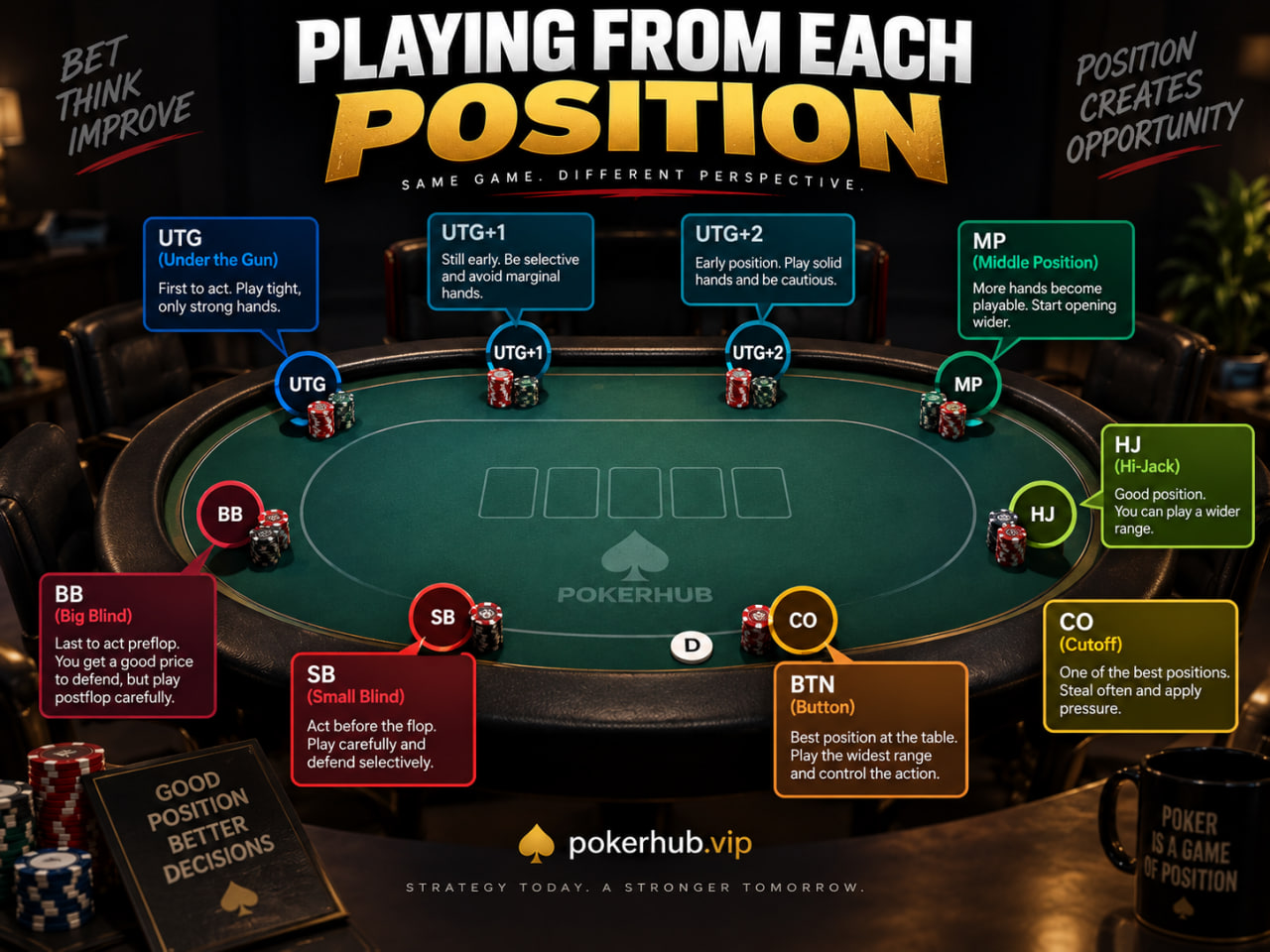
Under the Gun (UTG). First to act preflop, and the tightest seat at the table by necessity — there are more players left to act behind you than in any other spot, and any one of them could wake up with a premium hand. Open a narrow, mostly-premium range here: strong pairs, strong broadways, and your best suited aces. Speculative hands that play well in position — small suited connectors, weak suited aces — lose most of their value when everyone left to act can 3-bet or squeeze you off the hand.
Middle Position (MP/HJ). One or two players have folded, so the range opens up slightly — a few more suited broadways, a few more pocket pairs worth setting-mining with. It's still a raise-or-fold seat against unopened pots; limping invites the players behind you, who now have position on the rest of the hand, to isolate you cheaply.
Cutoff (CO). The first seat where position starts doing real work. Only the button and the two blinds are left to act, so a raise here is far more likely to take the pot down uncontested or go heads-up in position. This is where suited connectors, suited one-gappers, and a wider swath of offsuit broadways become profitable opens.
Button (BTN). The best seat in poker. You'll have position on every single opponent for the rest of the hand, on every street. This supports the widest opening range at the table by a large margin — most solvers open somewhere between a third and half of all hands here when the action folds around. Even speculative, weak hands can profit purely because of the information and initiative advantage that comes with closing the action.
Small Blind (SB). A strange seat: you'll act first on every postflop street against the big blind, but last preflop against everyone else. Facing an unopened pot, most winning players either raise or fold — limping into the big blind gives up the initiative for no benefit, since you're guaranteed to be out of position for the rest of the hand no matter what. Facing a raise, defend selectively; you're the worst-positioned seat to call from, so the hands you continue with need real playability, not just decent equity.
Big Blind (BB). You've already invested a chip, so getting a discount to see a flop changes the math — you can profitably defend a much wider range against a raise than you'd open from any other seat, because you're only calling the extra amount, not the full bet. The tradeoff is that you'll be out of position for the entire hand against every preflop raiser except the small blind, which caps how far a marginal hand can be pushed after the flop.
The rule "tighten up early, open up late" is simple to state and easy to under-apply. It's not just about which hands are strong enough to play — it's about which hands are strong enough relative to how many players are still left to act. A hand that's a clear open from the cutoff, with only three players left behind you, can be a losing open from under the gun, where six players are still waiting to wake up with a hand that dominates yours.
The same logic extends past the open. 3-betting ranges, calling ranges, and continuation-betting frequencies should all widen as you move from early to late position, and should all widen further when the players left to act behind you are tighter, more passive, or more likely to fold than average. Position isn't a fixed adjustment — it interacts with everything else at the table.
A useful way to build the habit: before you look at your cards, already know what your plan is for a raise, a limp, and a 3-bet from your current seat. Deciding your range before you see your hand keeps the seat driving the decision, instead of the two cards you happen to be holding pulling you into a wider range than the position supports.
Most positional advice scales smoothly from UTG to the button — get a little looser at every seat you move closer to the dealer. The blinds are the exception, because they're paying for the privilege of acting last, not earning it through position at the table.
The small blind is the seat most players misplay by defaulting to old habits: limping in because "I'm already halfway there." That logic ignores that the SB will be out of position against every single opponent for the rest of the hand — the discount on the call doesn't offset the information disadvantage that follows. Raise or fold is the standard default here for a reason.
The big blind is the opposite case: a closing discount that makes defending genuinely correct with a much wider range than the hand would otherwise justify, specifically because you're getting better pot odds than any other seat at the table gets to see. The skill here isn't defending wide — most players already know to do that — it's playing those wide, weaker hands well after the flop, since you'll be out of position against a raiser for the rest of the hand.
Fixing positional leaks rarely requires learning new hands — it requires playing the hands you already know how to play from the seats where they're actually profitable, and folding them everywhere else.
Positional edges compound fastest at tables full of players who haven't tightened up their early-position ranges.