🧠 Strategy · Mental Game

Mental Game & Tilt Control

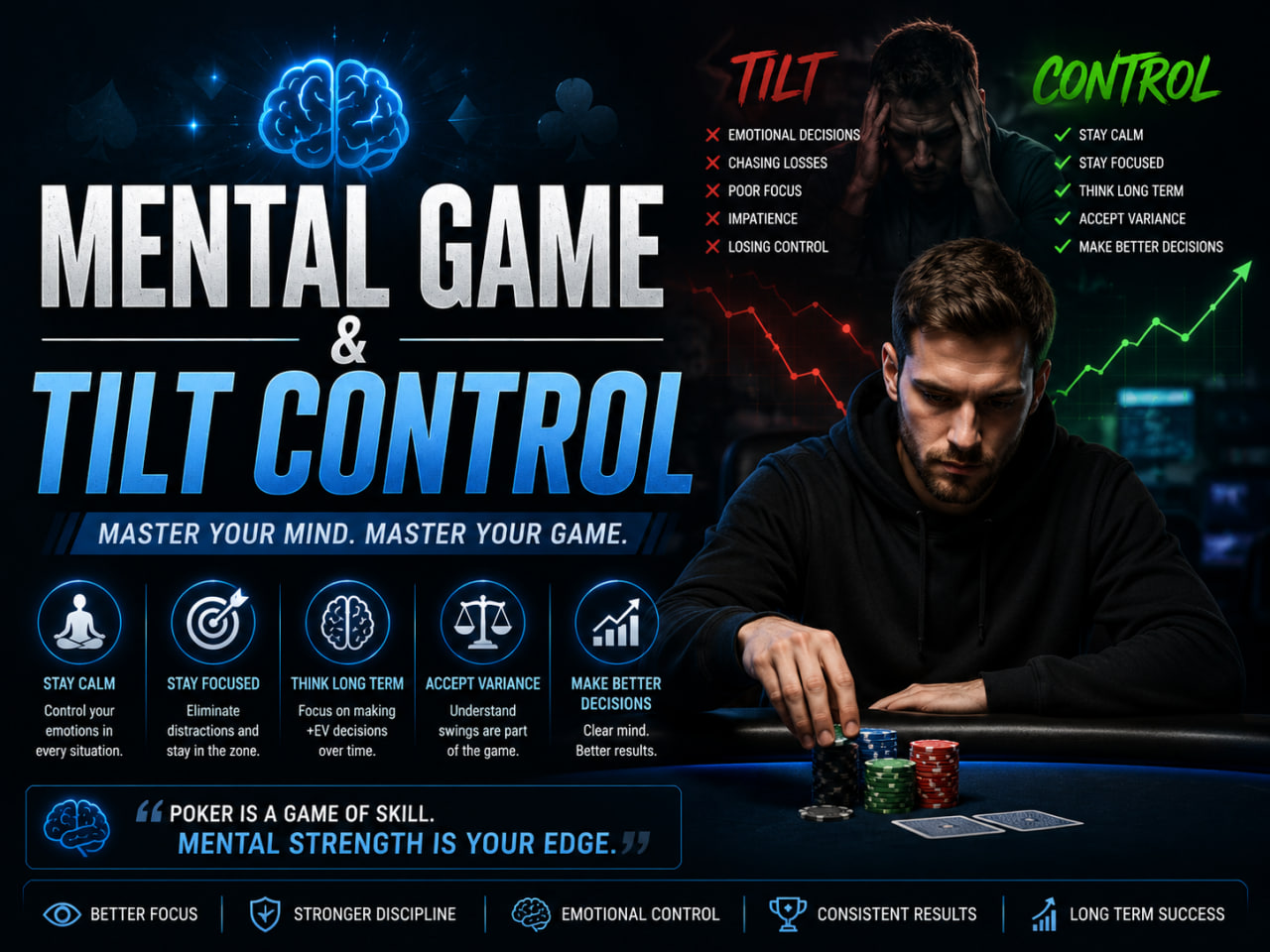
Master your mind. Master your game. Poker is a long-run game played one short-run session at a time.

Mental Game & Tilt Control — tilt versus control

Every strategy article assumes you'll actually execute the strategy. Tilt is what breaks that assumption. It doesn't change what you know — it changes what you do with what you know, usually right when the stakes (literal and otherwise) are highest. A player who studies ranges for ten hours a week and then blows three buy-ins in twenty minutes after a bad beat isn't making a strategy mistake. They're making a mental game mistake, and it costs far more.

The good news: tilt is a skill problem, not a personality flaw, which means it's trainable the same way ranges are. Poker is a game of skill — and mental strength is your edge.

Two Directions

Tilt vs. Control

Every session pulls you toward one of two states. Recognizing which one you're drifting into is most of the battle.

Signs You're on Tilt

  • Emotional decisions
  • Chasing losses
  • Poor focus
  • Impatience
  • Losing control

Signs You're in Control

  • Stay calm
  • Stay focused
  • Think long term
  • Accept variance
  • Make better decisions
Five Habits

Building Mental Control

Stay calm. Control your emotions in every situation — not just the big ones. The hands that bleed the most money are rarely the dramatic all-ins; they're the small, irritated decisions made two or three hands after something went wrong, before the frustration has actually passed.

Stay focused. Eliminate distractions and stay in the zone. A HUD full of stats or a table full of hands doesn't help if half your attention is somewhere else — focus is what turns information into decisions.

Think long term. Focus on making +EV decisions over time, not on how the last ten hands ran. A correct decision that loses is still correct; judging yourself by results instead of process is one of the fastest ways to talk yourself into bad adjustments.

Accept variance. Understand that swings are part of the game. Downswings happen to every winning player who's put in real volume — the difference is whether a downswing changes your strategy or just your mood.

Make better decisions. A clear mind produces better results, in that order. Every habit above exists to protect the thing that actually earns money: the quality of the decision in front of you, right now.

Routines That Hold Up

Turning Habits Into Rules

Willpower alone doesn't survive a bad beat at 2am on hour four of a session — rules set in advance, before emotion is involved, do. A few that consistently work:

Pre-session routine. Decide your stakes, table selection, and stop-loss before you sit down, not after a few hands tell you how the session "feels." Decisions made in advance are decisions your tilted self can't argue with as easily.

A hard stop-loss. Pick a number — in buy-ins, not emotions — where the session ends regardless of how you feel about your chances of winning it back. The instinct to keep playing until you're "even" is exactly the instinct tilt exploits.

A cool-down break. After any hand that spikes a strong emotional reaction, take a few hands off, or a few minutes away from the table entirely. The goal isn't to suppress the reaction, just to let it pass before it plays your next hand for you.

Session length limits. Decision quality degrades with fatigue well before it feels like it does. Capping session length protects you from the version of tilt that has no single trigger at all — just hours of accumulated wear.

The Bankroll Connection

Variance Hurts Less When It Can't Hurt You

A lot of what looks like a mental game problem is actually a bankroll problem wearing a mental game costume. Playing stakes where a single downswing threatens your ability to keep playing makes every bad beat existential instead of routine. Proper bankroll management doesn't just protect your money — it protects your decision-making, because losses stop feeling like emergencies.

If a normal, expected downswing makes you want to quit poker entirely, that's usually a sign the stakes are too high for the bankroll behind them, not that your mental game is uniquely weak.

Ready to Put It Into Practice?

Composed play matters most at rooms with soft, forgiving fields — the kind worth staying sharp for.

Related