Play optimal. Make better decisions. What "GTO" actually means, and how to use it without turning every hand into a memorization test.
GTO — Game Theory Optimal — gets thrown around constantly, usually as a synonym for "correct." That's not quite right. GTO describes a strategy that can't be exploited: play it perfectly against a perfect opponent and the game is unbeatable, but also unbeatably break-even. In practice, nobody plays perfect GTO, and nobody needs to. What's actually useful is understanding the handful of ideas underneath it, because those ideas explain why solvers recommend what they recommend — and that's what lets you use solver output instead of just memorizing it.
This isn't a solver tutorial. It's the mental model you need before opening one.
Range advantage. GTO strategy is built around the fact that your opponent can't see your cards — so instead of thinking "I have top pair," you think in terms of the full range of hands you could hold in that spot, and whether your range is stronger than theirs on this particular board. Every decision is really a decision about how your whole range behaves, not just the one hand in front of you.
Equity realization. Having the better hand on paper isn't the same as realizing that equity by the river. Position, initiative, and stack depth all affect how often a hand's raw equity actually turns into won chips — which is why some strong-looking hands play worse than they look, and some weaker ones play better.
Pot odds & EV. Every call is a bet that your equity plus your future edge beats the price you're being asked to pay. Thinking in terms of pot odds and expected value, rather than "do I think I'm ahead right now," is the foundation every other GTO concept builds on.
Bet sizing. Solvers don't use one bet size out of habit — different sizes put different pressure on different parts of an opponent's range, and the correct size shifts with board texture, stack depth, and how polarized your own range is.
Balance & frequency. A balanced range mixes value hands and bluffs in a ratio that makes your opponent indifferent between calling and folding. Solvers often play the exact same hand differently a percentage of the time — betting it 70% and checking it 30%, for example — not for randomness's sake, but to stay unpredictable enough that no single read can break the strategy.
Bluffs & value. A bluff only earns money if it's backed by a range that also shows up with real hands often enough. GTO ties your bluffing frequency directly to your value betting frequency on a given line, rather than treating them as separate decisions.
None of this requires a solver to understand conceptually. The solver's job is to tell you the exact numbers for a specific spot; your job is to understand why those numbers make sense so you can extend the logic to spots you haven't studied.
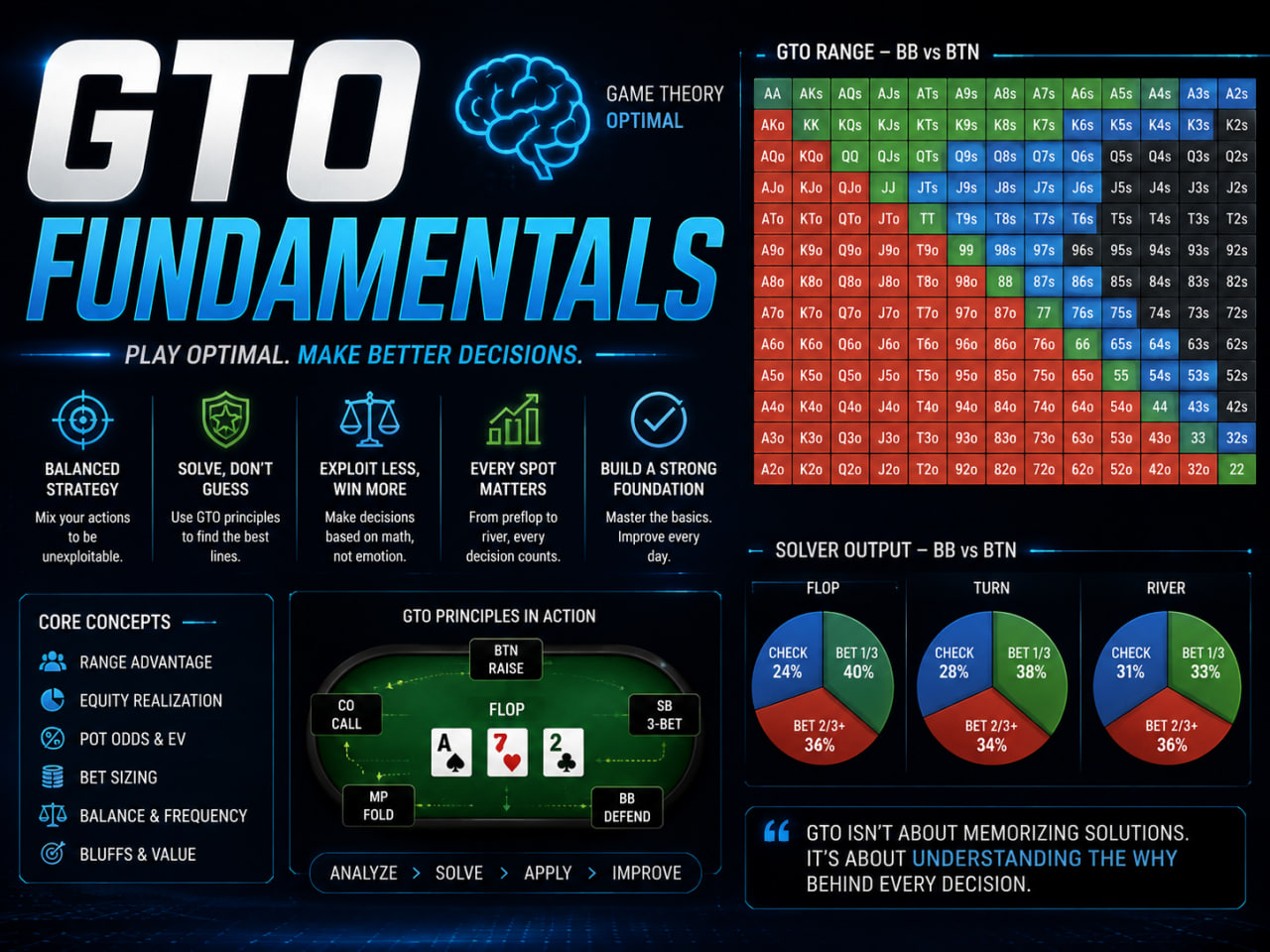
Take a common spot: the button raises, the cutoff calls, and the big blind defends. The flop comes A♠ 7♥ 2♣ — dry, ace-high, favoring the preflop raiser's range. The big blind checks, and now the button has to decide how to continue with their entire range, not just the specific hand they're holding.
A solver won't bet every hand here, and it won't check every hand either. It splits the range: strong aces and a set of well-chosen bluffs (hands with backdoor equity or blockers to the calling range) bet, while the rest checks back to keep pot control and avoid bloating the pot with a range that's too capped or too weak to keep barreling. That split — not any single hand's decision — is what "GTO" actually looks like at the table.
The habit worth building isn't memorizing this exact flop. It's the four-step loop behind it: analyze the spot, solve for what a balanced range does, apply the underlying logic at the table, and improve by reviewing how close your actual play matched it afterward.
GTO is a baseline, not a ceiling. It's the strategy that can't lose to a perfect opponent — but most of your opponents aren't perfect, and against a player who folds too much, over-bluffing them isn't a leak, it's free money. Playing pure GTO against a bad player leaves value on the table.
The practical approach most winning players use: default toward GTO-shaped ranges when you don't have a read, then deviate deliberately once you've identified a real tendency — someone who never folds, someone who never bluffs, someone who over-folds to 3-bets. GTO gives you a strategy that can't be punished while you gather information; exploitative adjustments are how you actually maximize win rate once you have it. The mistake to avoid is deviating on a hunch — a read needs a sample size behind it, and guessing your way into an exploit against a decent player is usually worse than just playing the balanced line.
Trying to memorize solver output node by node doesn't scale — solvers produce more data than any human can hold in their head, and most of it is for spots you'll rarely see. A more sustainable approach:
Free simplified charts and entry-level solver tools are enough to build real intuition before investing in a full solver license. The goal isn't to become a database of correct plays — it's to internalize the logic so unfamiliar spots stop feeling like guesswork. As the saying goes: GTO isn't about memorizing solutions, it's about understanding the why behind every decision.
Solid theory pays off fastest at tables with soft, exploitable opponents.