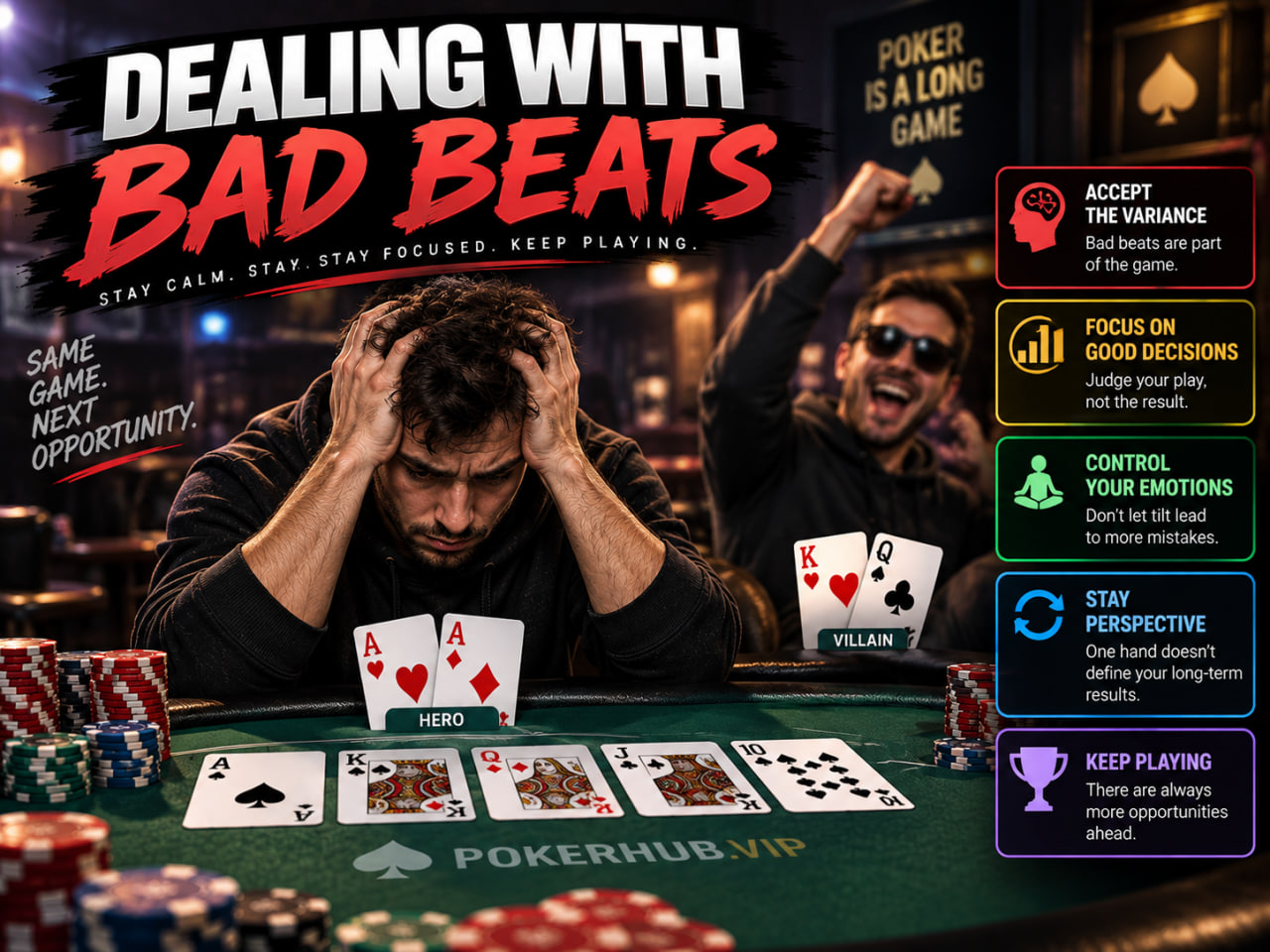
You got the money in as the favorite and still lost. That's not the game being unfair — that's the game working exactly as designed.
Every poker player has the story: pocket aces all-in before the flop, called by a worse hand, and a runner-runner card on the river that takes the whole pot. Bad beats are the most emotional moments in the game, and for many players they're also the most expensive — not because of the pot that was lost, but because of the decisions made in the hour after it.
Handling bad beats well isn't about not caring. It's about understanding why they happen, having a plan for the moment they do, and making sure one unlucky card doesn't cost more than the chips already in the middle.

A bad beat happens when a player gets their money in as a strong favorite and loses anyway. That definition hides the most important point: to suffer a bad beat, you first had to make a good decision. Your opponent put money in with the worse hand, and in the long run, that's exactly the mistake that pays your bills.
Poker profit comes from opponents making mathematical errors, and a bad beat is simply a mathematical error that happened to get rewarded this time. If weaker players never won with worse hands, they would stop playing — and the games would dry up. Every beat you take is part of what keeps the tables full of players willing to make those mistakes again.
Pocket aces against pocket kings all-in preflop win roughly 82% of the time. That sounds overwhelming, but it also means the kings win about one time in five. A four-outer on the river hits about 9% of the time — rare in any single hand, but common across the thousands of hands a regular plays each month.
The numbers compound quickly. Get it in as an 80% favorite ten times in a row, and the chance of winning all ten is only about 11%. Losing at least one of those pots isn't bad luck — it's the expected outcome. What counts is the expected value of the decision: calling all-in for 100 big blinds into a 200 big blind pot as an 80% favorite is worth about +60 big blinds on average, whether or not the river cooperates this time.
A simple routine for right after the beat:
The danger of a bad beat is rarely the lost pot itself. It's the next few hands played to “get it back” — looser calls, bigger bluffs, and revenge plays aimed at the player who just hit. A short, repeatable routine gives the emotional spike time to fade before it can make any decisions for you.
One bad beat costs one pot. A bad beat that turns into tilt can cost a whole buy-in or more. Watch for the warning signs: replaying the hand in your head, playing hands you would normally fold, calling down just to “see if they have it”, or moving up in stakes to recover losses faster.
Set rules before the session starts, when you're thinking clearly — a stop-loss of two or three buy-ins, or a rule to quit after two beats in a short span. Rules made in advance are much easier to follow than decisions made while angry. For a deeper toolkit on emotional control at the table, see Mental Game & Tilt Control.
Not every painful loss is a bad beat. Sometimes the hand that “sucked out” was actually getting the right price to call, or the money went in with a hand that was behind more often than it felt. Being honest about the difference is one of the fastest ways to improve.
Review the hand later — never in the heat of the moment — with an equity calculator. Ask two questions: was I ahead when the money went in, and was my line the best one given my opponent's likely range? If both answers are yes, let it go completely. If not, you've found a leak worth fixing, which turns an unlucky hand into a useful lesson.
Bad beats are guaranteed; going broke from them isn't. Proper bankroll management — keeping enough buy-ins behind for your stakes — means that even a brutal run of beats is a temporary dip rather than a crisis. When a single lost pot doesn't threaten your bankroll, it becomes much easier to shrug off emotionally.
It also helps to remember the beats you deliver. Every regular wins pots they had no business winning, and those hands are forgotten almost instantly while the losses stay vivid. Over a large enough sample, luck evens out. Your decisions are the only part that doesn't — which is exactly why they're the only part worth worrying about.
Get your money in good, let the cards fall where they may, and let the long run take care of the rest.